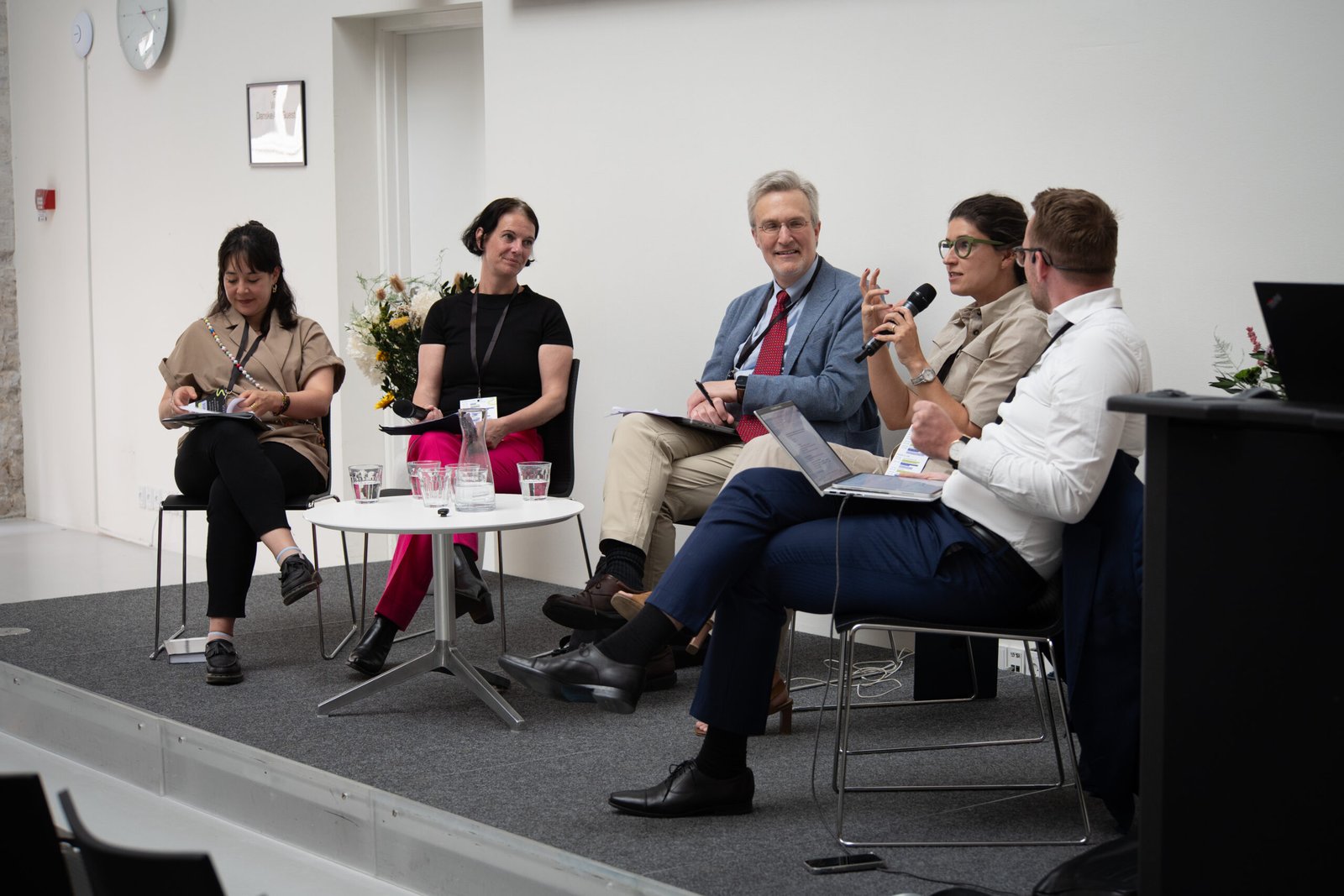
Ask a room full of procurement experts to describe the current state of AI in public procurement in one word, and you get different answers. That was the opening exercise at the PurpLE final conference, Public Procurement & Contracts: Navigating Today, Designing Tomorrow’s panel on public contracts, digitalisation and new technologies, chaired by Willem Janssen with Cary Coglianese, Diana Bowman, Alexandra Andhov and Rika Koch. Four jurisdictions spanning the US, New Zealand, Australia, Switzerland; four starting points; and little agreement on what “AI in procurement” is even supposed to look like yet.
WHY DOES “AI IN PROCUREMENT” MEAN SOMETHING DIFFERENT IN EACH COUNTRY?
Alexandra Andhov noted that New Zealand’s government recently announced plans to replace 9,000 public employees with AI, without saying how, and without an AI act or any national regulation, public procurement included, to structure the process. A real push to adopt AI, a genuine fear of missing out, and almost no regulatory scaffolding- that combination is what generated the concern: how do we actually do this?
Cary Coglianese said the US has around 100 documented AI use cases in procurement specifically. Two examples stood out. The US Army’s smart contracting initiative pilots a tool that helps staff draft acquisition requirement packages, cutting the time needed from weeks to hours, sometimes minutes. Massachusetts, with Northeastern University, built an assistive buyer engine, a chatbot that procurement officers consult directly for help with their own work. Neither tool takes the job over. Both just make it faster.
Coglianese’s closing point: procurement is only a subset of a much broader wave of AI adoption across government, in the US and, he suggested, everywhere.
Switzerland has no dominant AI procurement tool and no cautionary tale either, as Rika Koch highlights, mostly because adoption is still catching up. What exists instead is dozens of small, disconnected tools built by individual authorities for narrow tasks, market analysis here, supplier-side offer help there. Willem Janssen added that the Netherlands sits at a similarly early stage.
Diana Bowman’s contribution was the panel’s clearest warning, even though the case wasn’t a procurement matter at all. Between 2015 and 2019, an Australian welfare agency ran a fully automated income-verification scheme with no human sign-off, issuing wrongful penalty notices to hundreds of thousands of people. The point for procurement isn’t the scheme’s mechanics; it’s what it did to Australia’s appetite for automated decision-making generally.
CAN AI ACTUALLY HELP BEFORE THE TENDER EVEN OPENS?
Willem Janssen inquired about the AI’s real promise in pre-procurement: market analysis and understanding who’s out there to bid. Cary Coglianese’s answer with respect to the U.S. was that AI definitely gets used for market analysis, but he knew of no instances yet where such use gave rise to litigation—and indeed he explained why litigation over such pre-bid use is unlikely in the United States.
Rika Koch was sceptical if the technology adds much here yet.
That exchange led Janssen to a sharper question: could better market-analysis tools actually widen access for SMEs, who complain they’re invisible to public buyers? According to Koch, AI alone doesn’t reduce the burden on officials looking for suppliers.
Alexandra Andhov raised a further concern: today’s AI tools run on business models still searching for profitability, the same trajectory search and social platforms already followed toward influencing user decisions through design rather than content. In procurement, where one decision can commit tens of millions of euros, that’s a much higher-stakes version of a problem already visible everywhere else online.
SHOULD AI EVER TOUCH THE EVALUATION OF BIDS?
This is where Janssen expects the real legal friction to concentrate, since equal treatment, transparency, and proportionality are already the most important principles of procurement even without AI involved. Cary Coglianese’s example: the US Internal Revenue Service is piloting a system where uploaded contractor proposals get an initial AI-generated synthesis of strengths and weaknesses, not a decision, an input the human evaluator reviews.
His framing throughout was “responsible use” rather than any blanket rule. He also pushed back on treating bias as an AI-specific problem. Human decision-makers are inconsistent too. AI trained on data won’t be neutral by default, but it might be adjusted toward fairness in ways human institutions never quite managed.
CONTRACT MANAGEMENT: WHERE AI PROVES USEFUL
Contract management got the least airtime of the three phases, but Alexandra Andhov, drawing on her chapter (co-written with Sven Mikulic and Michal Kania) titled “Deconstructing Computational Contracts: A Critical Analysis of their Application in Private and Public Domain” in the recently published Public Procurement and Contract Law: Exploring Intersections, Defining Boundaries (eds. Marta Andhov, Michał Kania and Sylvie Cécile Cavaleri) launched at the conference, argued it’s where AI’s potential is actually strongest. Not decision-making, but oversight: fast analysis, quick review, comparing and monitoring provisions across large numbers of contracts at once, work that scales badly for a human team but naturally for a tool built to read at volume.
SO, WHAT UNITES ANY OF THIS?
Not much except for a shared, still-unresolved instinct that a human needs to stay accountable somewhere, pre-procurement, evaluation, or after signature, even as every panellist acknowledged how thin that safeguard can be in practice.
New Zealand may not be the only jurisdiction likely to replace public employees with AI rather than assist them. If others follow, procurement procedures may end up looking quite different from what this panel was comparing, and who’s accountable when something goes wrong is still an open question.

0 Comments